Whistling With An Ordinary Sweetheart
During the war, when the BBC played Vera Lynn’s The White Cliffs of Dover, the German guns , installed in France, opened fire on Dover. In the finalscene of Doctor Strangelove by Stanley Kubrick, a bombardment secene perversely enacted to the music of We’ll Meet Again, inverting the meaning of love with a message of spiteful obscurity. Also, she has taken legal action against the British National Party for selling a cd to its white supremacist followers using her rendition ofWhite Cliffs of Dover mixing the metaphor of white skin and anti-immigration.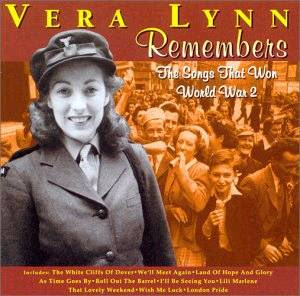
There’ll be blue birds over the white cliffs of Dover/Tomorrow just you wait and see/There’ll be love and laughter and peace ever after/Tomorrow, when the world is free/( White Cliffs of Dover)
Vera Lynn was an ordinary sweetheart, a metaphor for white picket fences and the complex pleasure and joy of the forgetting of time. An assurance that people like herself would see to it that there would always be an England. She broke through class barriers and brought mass culture to people of all walks of life. Perfect diction, free from affectation. A form of minimalism and encapsualtion of poignancy that connected with the elements of people, love and the distance between the two.
Although she was a cultural icon, an institution in Great Britain, there is also a deeper narrative to her story, a more progound articualtion of the marginal and alienated that is overlooked and ignored that is swept away by the phenomenon of being a coat hook on which to hang history, and sentimentality, a wistful gaze of a place and time that no longer exists, may have never existed, yet does exist in spirit and may today be lurking, read to articulate itself again.
” Her absolute devotion to British society and her symbolizing of its mainstream is especially interesting in light of her marginalization by this society. Her songs were scorned and derided by many, popular taste and pop music treated her with condescension at best, contempt at worst. Personally, Vera Lynn was a young working class woman, an East Ender and popular singer, married to another East End pop musician who also happened to be a jew. Yet nowhere in her writing is there any indication that she feels marginalized; to the contrary, she presents herself as absolutely representative, for that is what ordinary means. … far from showing any resentment towards a society in which working people cannot afford bathrooms, she is proof that democracy works.”
Vera Lynn’s lyrics reflected the mood of love and romance so prevalent in the post-war period.A melody of love in compositions that the Nazis would have banned as ”degenerate”. The peace dividend was her ability to connect into a collective consciousness at a time and place, as if she captured the energy and re-directed it elsewhere. An instrument of a larger force , a divine spirit choosing the unlikely medium of communicating.wishing to convey a message of optimism , hope and realism in a manner that defied almost any standard of measurement. It was a recall of a world almost gone in a world that had gone terribly wrong.

Dad's Army, BBC
Vera Lynn is a reconnection with the past. An evaluation of the extent in which myth does or does not coincide with actual behavior; the degree of authenticity that remains after a collision with factual truth. This central theme has been manipulated over time through the bias of memoirs, films and popular dramas which are part of a nostalgia machinery which promote the values of hardship and suffering as a necessary backdrop to the ultimate victory. Vera Lynn is a can opener who peels back the fluff and gloss re-opening an examination of memory.
Films such as The Great Escape and Bridge Over the River Kwai are stories and circumstances which are plausible, but their authenticity which is a vital ingredient, does not depend on true knowledge and the behavioral patterns are too standardized and cliched to capture the subtlety and intangibility of abstract truth.
”World War Two has become a tale of resistance to tyranny, freeing slaves, defense of the rights of the little man and democratic principles. It is a tale of ingenuity – of backroom boys inventing bouncing bombs, of muddling through (as with the story of the little ships saving the BEF at Dunkirk or the Home Guard of Dads Army). At its heart is an emphasis on an island standing alone. This is not the reality of World War Two – issues like the betrayal of Finland at the beginning of the war – or the ambiguity of lining up with Stalin in Europe hardly fit this story, but it helps to account for the attachment to the story and exactly why World War Two could be viable as England’s only historical memory.”( Nicholas J. Cull)
The role of song among soldiers, particularly those taken prisoner or under extreme tension was a means to keep sanity and a sense of community. Percy Wilson Carruthers wrote eloquently and factually in his memoir ”Of Ploughs Planes and Palliases” the use of song among the POW’s or ”kregies” based in a Lithuanian Stalag and how singing was seen as an act of defiance to their captors.
Her recent release, or anthology of songs,”We’ll Meet Again-The Very Best of Vera Lynn” has been no. 1 on the British charts, with sales surpassing the new Beatles compilations.
 About This Post