LEGENDS ON THE WILD SIDE
Of all creatures on earth, the rhinoceros appears at first glance the least likely to be associated with the art of love. The great horn that decorates his nose, and from which his name is derived, is not generally considered an object of beauty and endearment. Yet the belief in this horn’s aphrodisiac and other magical properties has existed for countless centuries. And incredible as the fact may seem, the persistence of this belief down to our own day is a deadly threat to the existence of the comparatively few rhinos left on earth. Most people scarcely realize that the rhino comes in various shapes and sizes, some of which could eventually be permanently off the market.

Detail French Tapestry. 1600. A unicorn is about to lay his head in a maiden's lap, signifying purity.
The story of the rhino is a head on collision of modern science and ancient myth. With that living ”fossil”, the rhinoceros, the situation is complicated. He is neither loved or hated, but he has been senselessly persecuted and misunderstood. The rhino, more than any other great mammal, is a living link between our world and the world of the past. Of the many types of rhinoceros that once walked the earth, including the wooly rhino that was a contemporary of the mammoth, five species have lasted until today; two in Africa and three in Asia. All five can be traced back into the Tertiery period, before the Ice Age, long before the emergence of humans.
To understand the rhino’s situation is a tortuous voyage back to the days of Marco Polo, full of crosscurrents and dark whirlpools where myth and science join and separate and join again. The object of the search is the most treasured animal of the medieval world; the most treasured and necessarily the most elusive, since its value depended on the fact that it did not exist.
The unicorn that faces the lion on the British coat of arms, or the delicate prancing creature of The Unicorn Tapestries, seems about as remote from a rhinoceros as a butterfly from a caterpillar, and is as close. At the base of the unicorn legend, as Odell Shepard showed in his ”Lore of the Unicorn”, lay distorted descriptions of the rhinoceros, whose features were blended with those of other animals; some very strange compounds, but ultimately more rhino than anything else. By the Middle Ages the connection between rhinoceros and unicorn is taken for granted.

The Hunt of the Unicorn Tapestries. 1500
”Starting home by ship in 1291 or 1292, Polo was forced to spend five months on “Java the Less”—Sumatra—waiting for monsoon winds to shift so that he and his shipmates could sail northwestward toward Ceylon and India. Polo reported, accurately, that cannibals dwelled on Sumatra and, less accurately, that the island was home to some strange beasts, including enormous unicorns, in size “not at all by any means less than an elephant.” ”I tell you quite truly,” Polo continued about Sumatra, “that there are men who have tails more than a palm in size.” And on an island that he called Angaman—probably referring to the Andaman Islands in the Bay of Bengal—”all the men…have the crown of the head like a dog and teeth and eyes like dogs.” Tales of strange creatures abounded in Asia as well …” ( Smithsonian )
The technique for hunting the unicorn, described in Richard de Fournival’s ”Bestiare d’amour” involved capture by virgins as the approved method of capture, who would lill the unicorn to sleep in their laps, allowing skilled hunters, who would not dare appraoch him when awake, come up and kill him. An unsportsmanlike procedure, but in a field where anything is fair. We are dealing here less with the chase than with that other blood sport, the art of love.

The Woman With The Unicorn , Raphael. 1505
”I have been drawn to you by your sweet odour alone, as the Unicorn falls asleep under the influence of a maiden’s fragrance. For this is the nature of the Unicorn, that no other beast is so hard to capture, so that no one dares to go forth against him except a virgin girl. And as soon as he is made aware of her presence by the scent of her, he kneels humbly before her and humiliates himself as though to signify that he would serve her. Therefore wise huntsmen who know his nature set a virgin in his way; he falls asleep in her lap; and while he sleeps the hunters come up and kill him.” (de Fournival, as quoted in Megged, 1992, 30–31)
The valuable part of the unicorn was, of course, the horn. In days when poisoning was an accepted method of political advancement, the well known fact that a unicorn horn would sweat or change color in the presence of poison made it a useful accessory to the banquet table. of all the medicinal and shamanic myths of the horn whether in shard or powdered form, it is the stubborn belief of being able to prolong youth that continues to persist. One has only to substitute the rhino’s horn for the unicorns to realize the ancient origins of the conservation issue.Scientific evidence shows that the rhino horn has zero effect on people, except perhaps psychologically, but this does not deter potential purchasers.

Albrecht Durer's somewhat imaginative engraving of the Indian rhino. 1515.
Unicorn horns or ”alicorns” were king’s treasures. Up to the time of their civil war, the English treasured the horn of Windsor” which once belonged to Queen Elizabeth I. This horn was apparently picked up on an island in Frobisher’s Strait in the Canadian arctic. It is possible, since the alicorn of medieval Europe, the straight sharp, spiral horn depicted in The Unicorn Tapestries, was in actuality the single spearlike tusk of that Arctic member of the whale family, the narwhal.
The equally real, if less beautiful, horn of the rhino entered Europe from the opposit direction, through the growing trade with the Indies. Like alicorns, rhino horns were carved into drinking cups to safeguard against poison, as still is illegally done in Nepal and parts of India. In the form of a powder, rhino horn was also used as an antidote for all ills, including impotence.
As a creation of humankind’s imagination, the unicorn is immortal. However, the living prototypes have a more precarious existence.Poaching and the web of superstition relating to fertility have not helped the rhinos augment their ranks. In addition, exploding human populations,and the need for agricultural land have restricted the rhinos habitat to a few pinpoints on the map.

Dali. Giovane. 1954. Dali commented: "The rhino horn is indeed the legendary unicorn horn, symbol of chastity. The young lady may choose to lie on it or to morally play with it; as it was usual in courtesan love epochs".
In a wholly tamed and manicured world there would be no room for the rhinoceros. He would become as much of an anachronism as did the unicorn in the age of reason. Meanwhile, as the rhino becomes scarcer, the actual market price for his horn goes up. There are no rhinoceros farms as a cash crop, and no known or publicized efforts are available concerning the cloning of the different species. The rhino’s supposed contribution to the art of love has and remains, the greatest threat to its existence. He is battling for life against a legend.
Salvador Dali was an artist, whom, like many of the great masters before him, attempted to grasp form and to reduce it to elementary geometrical volumes. Leonardo always tended to produce eggs Ingres preferred spheres, and Cézanne cubes and cylinders. Dalí claimed that all curved surfaces of the human body have the same geometric spot in common, the one found in this cone with the rounded tip curved toward heaven or toward the earth the rhinoceros horn. After this initial discovery, Dalí surveyed his own images and realized that all of them could be deconstructed to rhinoceros horns.
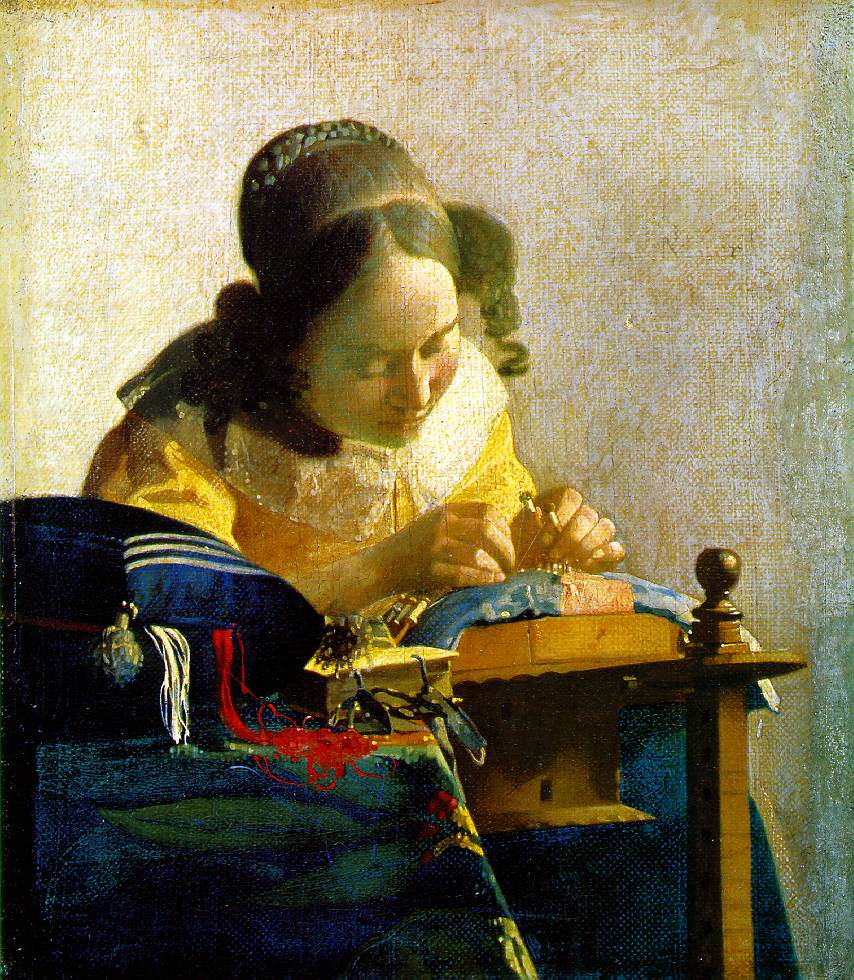
Vermeer, The Lacemaker
Dalí also discovered what he termed “latent rhinocerisation” in the works of the Great Masters. The Lacemaker is a rhinoceros horn (or an assemblage of horns), and the rhinoceros’ actual horn is, in fact, a Lacemaker. The painting triumphs over the living rhinoceros because it is entirely comprised of these animated, spiritualized horns, whereas the rhinoceros wields only the single diminutive horn/Lacemaker on its nose.”
Dalí explained, “Up till now, The Lacemaker has always been considered a very peaceful, very calm painting, but for me, it is possessed by the most violent aesthetic power, to which only the recently discovered antiproton can be compared.”“…the first time I saw a photograph of [Vermeer’s] Lacemaker and a live rhinoceros together, I realized that if there should be a battle, the Lacemaker would win, because the Lacemaker is morphologically a rhinoceros horn.”

“Velazquez Painting the Infanta Margarita With the Lights and Shadows of His Own Glory”.Dali Planet
”Encountering Dali’s discussion of the rhino and his free use of the modifier ‘rhinocerontic’ throughout his career, one is tempted to apply well established rhino archetypes to decipher the statement. However, Dali, direct as always, is simply referring to his earlier essays on the fundamental forms. Raphael, he says, used the egg. Leonardo was a proponent of the cylinder. Dali, in “50 Secrets of Magical Craftsmanship,” discusses the discovery of the form that is actually the most fundamental in nature, the logarithmic curve, as in a rhinoceros horn. He is fascinated by his own ability to express any form as an arrangement of rhino horns. Dali uses the term rhinocerontic to describe things that are fundamental and logical, such as the undeniable presence of Voltaire in the market, as opposed to the normal rhino image, which usually implies large things barreling towards other, smaller, things. Dali’s use of the term is not opposed to , or even conceptually linked with the more common imagery of the rhino. Now the quote becomes clear, even with no familiarity with the Lacemaker (a reading of his thoughts on Vermeer and the Lacemaker, present in one form or another in most of his writings, renders the quote helplessly transparent). The rhino cannot defeat the Lacemaker, because he has only one horn, while the Lacemaker is composed, at the most elementary level, of countless horns.( Josh Sonnier )
”The apparent incongruity of The Lacemaker with rhinoceros horns is resolved upon investigation of Dali’s obsession with perfection of form. The horn is an example of a planar logarithmic spiral, similar to that created in the gnomonic expansion of the golden rectangle. For Dali, the rhinoceros horn was a perfect organic shape, and he often used it in formal deconstructive analysis of pictorial composition. An even more famous example of this sort was the Dalinian masterwork of 1958, Velasquez Painting the Infanta Margarita with the Lights and Shadows of His Own Glory. Created to honor the 300th anniversary of the death of Velasquez, this piece also features the rhinoceros horns, which converge to define the head of the Infanta. It is quite an unusual effect: evocative, beautiful, and yet somehow disturbing.” ( Aaron Ross )
 About This Post


I find the idea intriguing as to what do we perceive when looking at art. It is interesting that the unicorn laying of his head in the lap is to symbolize purity when to me it has erotic undertones. Maybe this is from living in this age and not the age of the painting’s production. Check out my Erratic Thoughts blog at http://raphe1969.blogspot.com/
thanks for reading. You have a neat little blog yourself. the undertones may have been intentional, at least I am leaning that way, though the erotic component may not have been dominant, at least in the sense as is perceived in the West. Stay in touch,
Dave