Sister Substitutes for the Class Conscious
The war as a reliable barometer on the viability of the arts and cultural memory. The relationship bewteen culture and memory is no more pronounced than it was in wartime London where, due to circumstances beyond control there was a necessity of the more favored classes to interact with lower and working class Londoners since the city was being indiscriminately bombed.
” One of the remarkable accomplishments of the wartime concerts was to adapt the presentation of classical music to a working class milieu: concerts were cheap or free, were performed at lunchtime, and in many cases were taken to people’s places of work. Since first class musicians such as Myra Hess and Yehudi Menuhin performed at these concerts, it was not a case of selling the castoffs at bargain price. At times custom may be stronger than law, and breaking the class bound customs of art music presentation was no easy thing.”
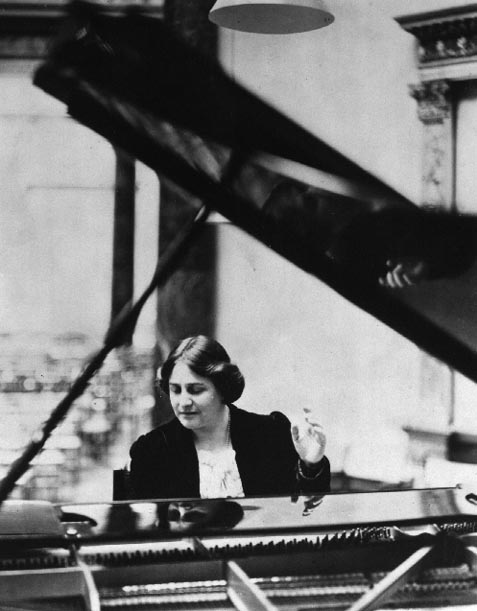
Myra Hess
Musical sound, composition and narrative dimension has in itself, no inherent or direct class connotation. However, the accoutrments of musical performance are filled with a basket of symbols and iconography that create the division; where broad matters of education are further stratified by meaningless distinctions unrelated to acceptable mannerisms and ethics.
The attitude between the higher and lower arts was aggressively ambivalent,mutually antagonistic at the same time there was a recognition that the factionalism makes no sense. Art critic Spike Hughes:
” Much as I hate to doubt that these musically illiterate thousands do enjoy Good Music, I am churlish enough to think that they listen to good music because they are fed up, far from home, have the music brought to them and have little freedom to escape to to the things they want to… Music ( ie. good music ) has a thoroughly bad reputation among the masses, towards whom the so-called ‘music lover’ behaves as an unnecessary and unbearably superior person… well, democracy isn’t all a matter of raising the lower ones up; the higher ones have got to come down and see what’s going on in the four ale bar, and then everyone can graduate to the saloon-bar and a good time can be had by all. ”
Like Vera Lynn, Myra Hess also came from the margins of British society and ironically ended up symbolizing its center and exemplifying middle class arts. They were like sisters separated at birth and served as sister substitutes to the listening public. Lynn was sentimental, poignant and optimistic in turning songs of hardship into pleasure; cleverly switching back and forth between major and minor keys similar to what McCartney did with ”Yesterday”, wistful and hopeful songcraft that was nonetheless refreshingly authentic.
Myra Hess never had to defend the music she played due to the inherent respectability of art music, however a woman performing artist was shocking at the time. This was mitigated by Hess’s presence which was devoid of the mannerisms and affectations of many of her contemporaries that were manifested through emotional and unrestrained playing. She used her instrument as a conduit for spiritual joys without condescending to popular tastes and complacent musical construction.Transcendent qualities were attributed to her because of her complete concentration while playing. She became a celebrity through her lunchtime concerts at the National Gallery.
in private, Hess was decidedly in the lower arts; she enjoyed drinking and eating to some excess, provocative public smoking, and was a great raconteur of humour and jokes clearly of the vulgar and crude variety. A Rabelaisian sense of existence bordering on the bohemian.
” Myra Hess has not allowed the highest standards to be relaxed- never in her own playing, and never so far as is humanely possible, in the choice of artists to play here. To maintain this sense of quality, this feeling that these are standards which must survive all disasters, is the supreme function of music in war-time. … the art of music, it has been able to fulfill in war essentially the same purpose which it fulfilled in peace- that of maintaining through beauty our faith in the greatness of the human spirit.”
Both Hess and Lynn represented a progress for democracy and transformed the mainstream by becoming part of it. They reflected the sociologist Warner’s study and conclusion of social class in the United States: To a large degree social class is based on attitude or shared attitudes in conjunction with occupation and income level. Both artists represented a positive community of integration with a democratically based status of membership in counterpoint to the Axis powers, particularly Germany, who with the SDP had achieved a community of interests that was nuanced between all social classes and based on the values of totalitarianism according to Richard Hamilton in ”Who Voted For Hitler”. here, the marginal were able to symbolize the mainstream during the war, but for opposite reasons.
”Far more controversial is his ( Hamilton ) argument that, in the major cities, the upper and middle classes gave more support to Hitler than the lower bourgeoisie ”
 About This Post